
Collaborating partners
- Jožef Stefan Institute (programme coordinator)
- University of Ljubljana, Faculty of Electrical Engineering
- University of Ljubljana, Faculty of Computer and Information Science
- University of Ljubljana, Faculty of Mechanical Engineering
- University of Maribor, Faculty of Electrical Engineering and Computer Science
- Rudolfovo – Science and Technology Centre Novo Mesto
- TECOS
- Yaskawa Slovenia
- Metronik
- Gorenje
- SICK
- INEA
- Adria Mobil
- RETTRO
- Fotona
- Elvez
- Keko Equipment
Funding
- European Regional Development Fund (ERDF) – JR RR PROGRAMI (TRL 3-6)
Researchers


Emerging technologies for smart factories
Prihajajoče tehnologije za pametne tovarne — SMARTFACT
The programme aims to develop advanced technologies for smarter, more flexible and more efficient production. It combines artificial intelligence, machine learning, computer vision, robotics and advanced methods for process control, laser processing and plasma processing.
The main results will be new methods, algorithms and prototype solutions for monitoring, optimising and automating production processes, detecting defects, quality control and flexible operation of production systems. The solutions will be validated in industrial environments and will contribute to higher quality, productivity, energy efficiency and competitiveness.
SMARTFACT brings together 17 Slovenian research and industrial partners to develop and validate technologies for more efficient, flexible and sustainable manufacturing. The programme is coordinated by the Jožef Stefan Institute. Within this wider consortium, ViCoS at the University of Ljubljana, Faculty of Computer and Information Science (UL FRI), contributes targeted research in computer vision and machine learning for industrial inspection.
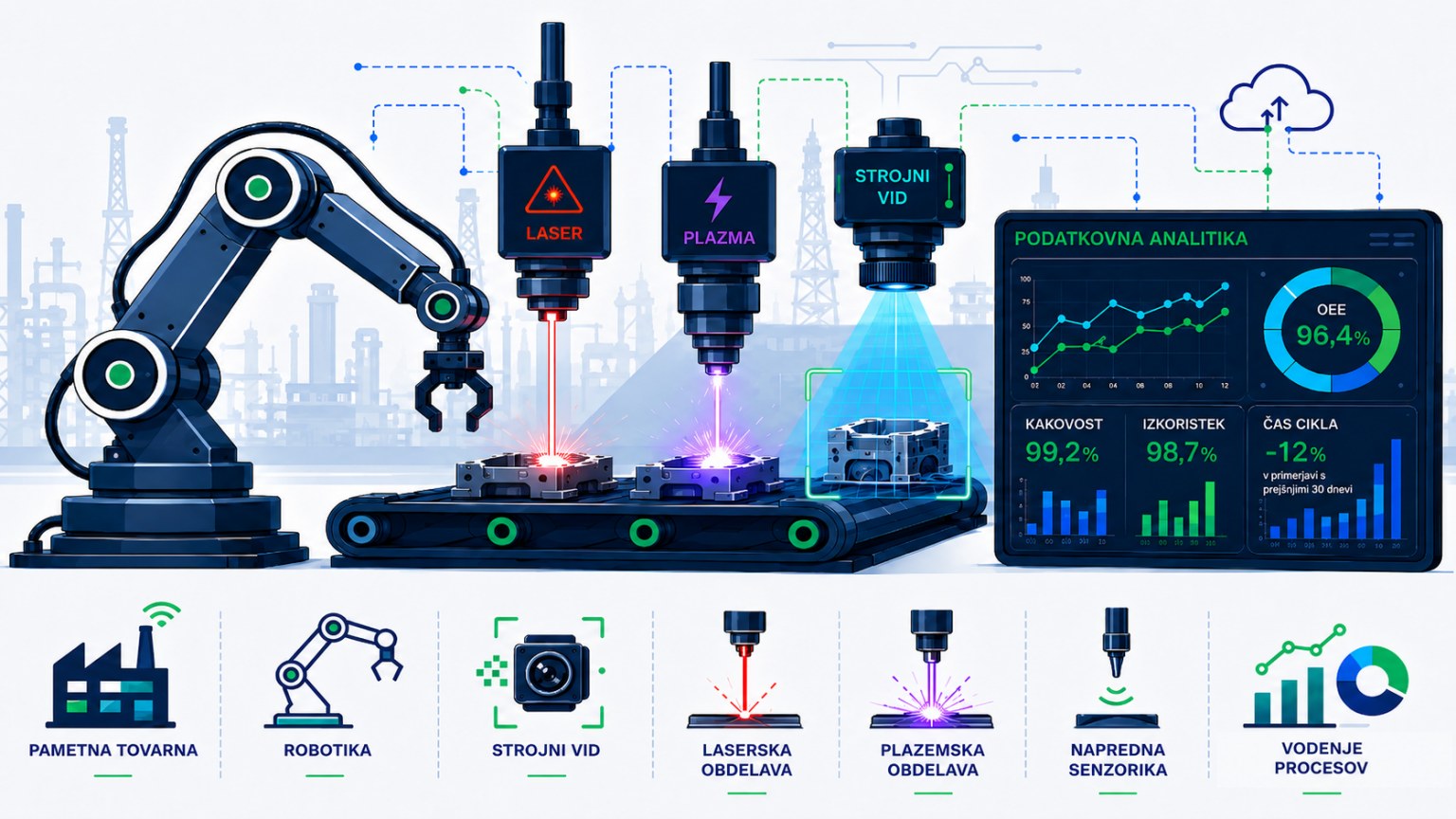
Programme overview
SMARTFACT integrates artificial intelligence, robotics, machine vision, laser processing and plasma technologies. Its activities progress from industrial research at TRL 3–4 to prototype development and demonstrations at TRL 5–6. The programme is organised around four interconnected thematic pillars:
- AI-supported process control,
- robotics of the future,
- laser processing for electronics, and
- plasma technologies.
UL FRI (ViCoS) contribution
The ViCoS team focuses on AI-based visual inspection for automated quality control, particularly where defects are rare, annotations are limited, or inspection conditions change. Planned work includes:
- Adaptable surface-defect detection (in collaboration with Gorenje and TECOS): developing and evaluating fully supervised, weakly supervised, few-shot and one-class unsupervised methods, including approaches that combine defect-free data with only a few defective examples.
- Configuration of machine-vision solutions (in collaboration with SICK): developing novel models for defining configurations of solutions to vision problems within existing software frameworks for machine-vision solutions.
- Inspection for micro- and nanomanufacturing (in collaboration with RETTRO): adapting deep-learning-based defect detection to microscopic structures, using the desired nanostructure geometry to guide inspection, and supporting visual feedback for laser-process optimisation and integration into RETTRO’s CAD/CAM software.
The work is planned for validation with industrial partners in representative use cases, including metallic appliance surfaces, configuration of machine-vision solutions, and optical inspection in micro- and nanomanufacturing.
Funding and duration
SMARTFACT runs from July 2026 to June 2029. It was selected under the public call JR RR PROGRAMI (TRL 3-6). The total value of the operation is 14.691.133,33 EUR, with 8.832.720,83 EUR in co-financing.
Further information
See the official SMARTFACT programme website for consortium-wide information and updates.
Information on European cohesion funding in Slovenia is available at evropskasredstva.si.